
Konrad Mägi 1878-1925
2141

Konrad Mägi
Nature was both home and church to Estonian artist Konrad Mägi, whose major exhibition is now on show at EMMA
The exhibition The Enigma of Painting is the largest to feature Konrad Mägi’s art outside Estonia to date.

Konrad Mägi’s prime period of painting occurred when he was at Saaremaa in the early 1910s. The picture shows Saaremaa Motif, 1913. Photo: Stanislav Stepashko
8.10.2021 Helsingin Sanomat
Timo Valjakka
Konrad Mägi – The Enigma of Painting is on show until 23 January 2022 at EMMA – Espoo Museum of Modern Art (Ahertajantie 5, Tapiola). Tue, Sat, Sun 11–17, Wed–Thu 11–19, Fri 11–21.
The Estonian painter Konrad Mägi (1878–1925) is not well known in Finland, although he is considered the most important modernist of his native country. That gap is being mended by The Enigma of Painting, the most comprehensive exhibition of Mägi’s art to be held to date. Curated by Pilvi Kalhama, director of EMMA, the show comprises nearly 150 paintings and drawings from Mägi’s oeuvre of around 400 works in total.
The exhibition is timely. The art world has recently been paying attention to the forms that modernism has taken when blended with different local traditions, a discussion that has raised a number of hitherto almost unknown and marginal artists. One of them is Mägi, whose works have in recent years also been shown in Rome and Paris.

Konrad Mägi applied styles such as pointillism in a highly personal manner. Landscape in Pühajärve. Photo: Stanislav Stepashko
Estonian modernism has not always had it easy. In the Soviet Estonia of the 1940s and 1950s, Mägi was branded a reactionary and his paintings were forbidden from display. They could only be seen in museum storerooms and even then only in secret. The ban was only lifted in 1959, whereupon the Tallinn Art Museum organised a retrospective exhibition of his work.

Konrad Mägi 1878–1925
Born in South Estonia, Mägi began his art studies in Tartu in 1901 and continued them in St Petersburg in 1903. In summer 1906, he worked at the Önningeby artist colony in Åland, and in autumn he moved to the Finnish Art Society’s drawing school in Helsinki; the following autumn he studied at the free art academies in Paris.
Mägi created his first significant paintings while living in Norway from 1908–1910. They also marked his breakthrough in his home country of Estonia.
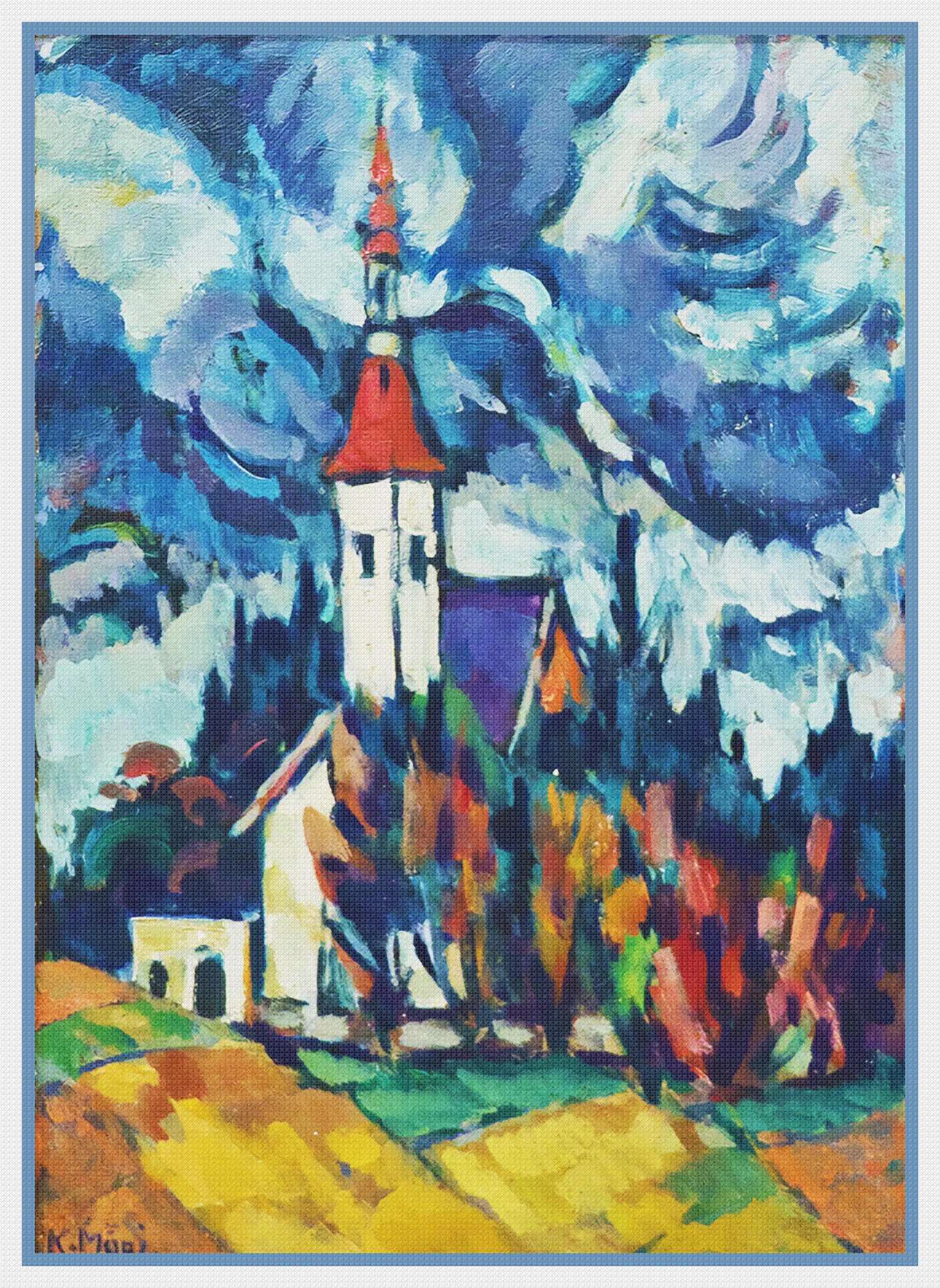
The works painted in Norway contain many of the elements for which Mägi later came to be known. Although Mägi’s oeuvre includes still lifes and portraits, he was most at home with landscapes. For a poor artist suffering from health problems and interested in spirituality, nature was both home and a church.
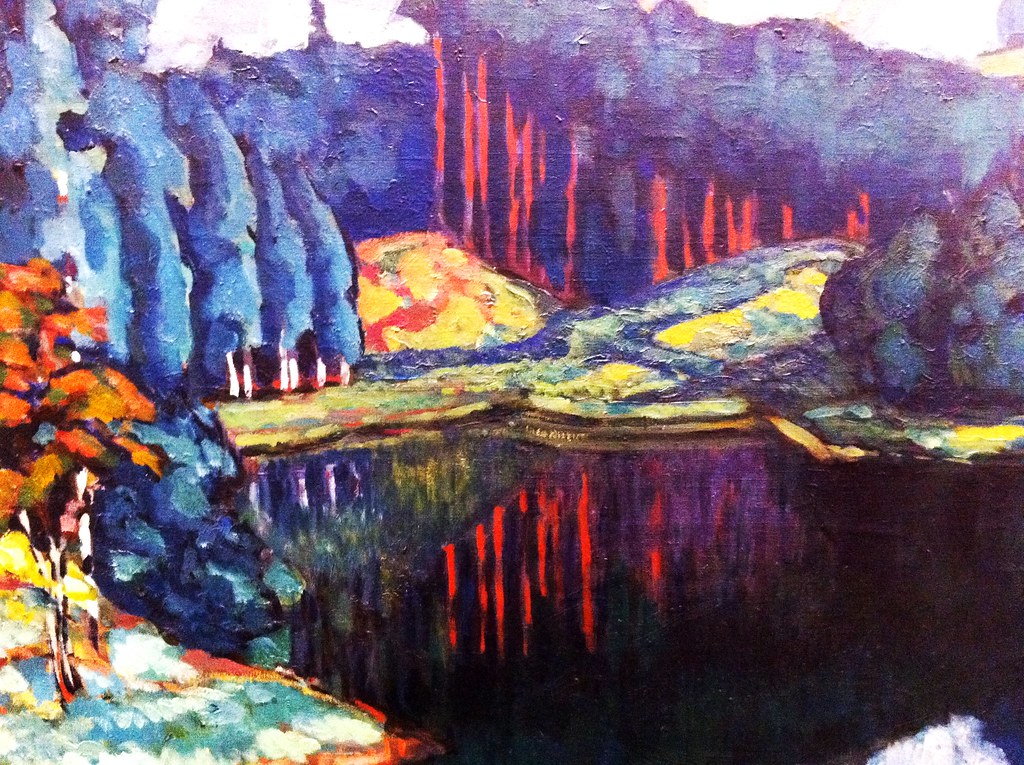
Visible reality was only a starting point for Mägi, however. His early paintings have a strong symbolic quality, and above all they are projections of his inner feelings. The results are almost psychedelic at times, such as Norwegian Landscape with Pine (1908–1910).
Mägi’s prime period of painting was at Saaremaa in the early 1910s. It was on the shores of the island that he created his most complete and also his most famous landscapes, such as Saaremaa Motif (1913).
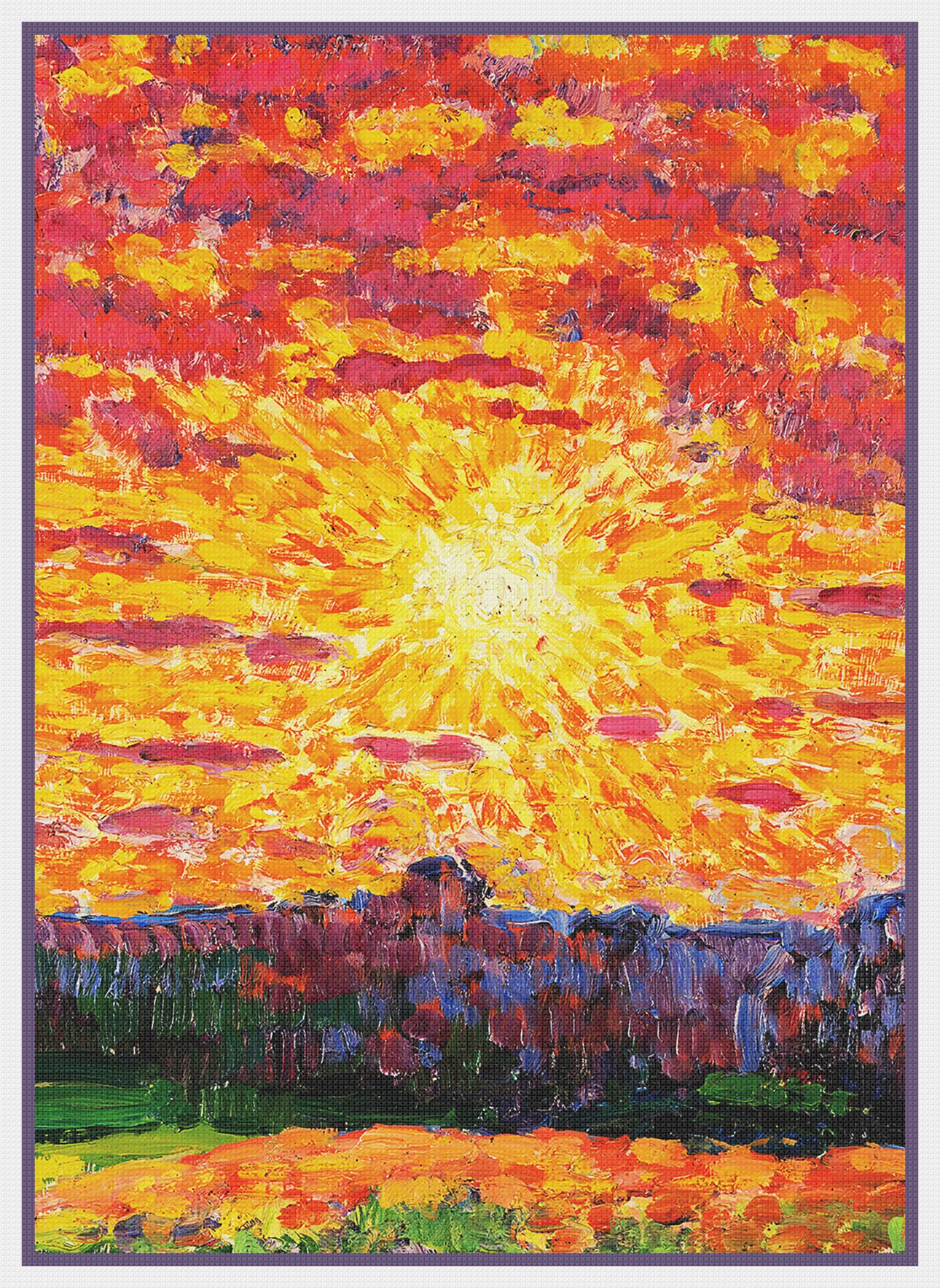
Although Mägi had encountered pointillism in Paris, he applied the technique in his own way, without regard to theories. Short or dot-like brushstrokes make the contrasting colour surfaces bloom like coral and radiate the bright, sharp light of the North.
The colours in the landscapes are hyper-real and the combinations surprising: ochre, pink and turquoise. It sometimes feels as if Mägi tried to capture all the seasons in his paintings at once.

Konrad Mägi: On the Road from Viljandi to Tartu. Photo Stanislav Stepashko
Mägi’s art in the 1910s was also quite original, even internationally. Although he was aware of events in the art world in Paris and Berlin, he never copied the influences he received, instead letting them filter through his powerful inner vision.
Although Mägi painted in solitude, he was not alone. At the time, many other pioneers like him occupied the northern fringes of modernism, such as the Russian-born Nicholas Roerich and the Icelandic artist Jóhannes Kjarval.
Mägi’s decidedly blue-toned views from Italy, painted in the 1920s, add one more name to the short list of possible influences. He seems to have closely studied the works of the German Die Blaue Reiter group, Wassily Kandinsky’s works in particular.
Kandinsky discovered abstract art through Russian folk art and expressive landscapes. Mägi’s last landscapes from Estonia are a form of prismatic, light-filled cubism, just a few steps away from abstraction.
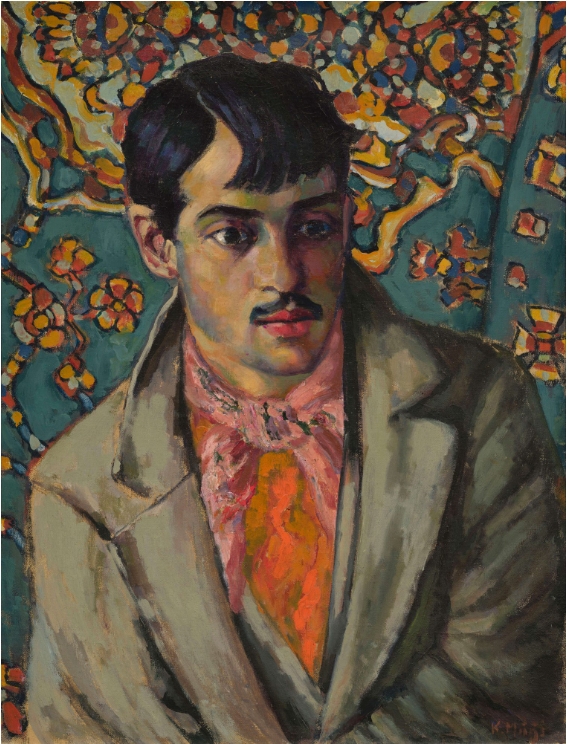
Young Rom
As with the Romani girl, Konrad Mägi also probably painted this portrait of a young Romani man in the late winter of 1915 in Viljandi, (see Romani Girl, Art Museum of Estonia). Unlike the girl, the man is of Russian origin, as he is not as dark-complexioned as the girl. He, too, appears to be from the upper echelons of Romani society, as indicated above all by his costly blazer. Zalina Dabla, the chairwoman of the Estonian Roma, says this may even signify that the model is the chieftain’s son. The head covering is a usual part of Romani sartorial culture; his moustache is a cultural norm, as it distinguished a man from a boy and was a symbol of masculinity and never shaved off. The tapestry behind his back is not hand-woven but a wall covering from Russia with a fairly ordinary pattern.
The painting is from the First World War era when many Roma fought in the tsarist army. As a result, they had a relatively good reputation and the state gave them horses as a token of gratitude. It is impossible to determine whether this particular man’s wealth could have been due to services rendered in the war.
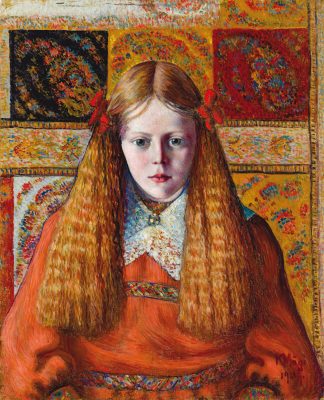
Portrait of a Norwegian Girl
On 9 June 1910, Konrad Mägi wrote his friend and agent, Eduard Virgo, who was working as a journalist then: “As for my pictures in Helsinki, there are so many bad ones that I can’t exhibit, only perhaps sell privately. For example, there are some landscapes and the picture of a girl’s face in the larger folder. They can’t be put out on display, because as far as I remember, they are very poor.” It is possible that the picture of the girl’s face Mägi was disparaging was the Portrait of a Norwegian Girl, which is now one of his best-known works.
The model is believed to be the 14-year-old daughter of the Norwegian politician Adam Egede-Nissen. Her name was Gerdi and later, as Gerdi Grieg, she would be a famous star of the screen and stage. Egede-Nissen, the father, was a well-known politician, elected to parliament on the vote of the fishing community in the north of the country. Due to his left-wing views (he later founded the Norwegian Communist Party) had close interactions with Russian emigrants, a group with which Mägi also socialized – and virtually belonged to. Egede-Nissen, a supporter of Lenin (and later, Stalin as well), was an extremely friendly and warm person who always tried to help those in a weaker position than he; he also had Mägi over for dinner many times. At these meals, they almost certainly talked politics, too.
The red colour in the work may have also been a reference to the father’s political views, yet Mägi made heavy use of that colour throughout the Norwegian period (see e.g., Norwegian Landscape with a Pine Tree) and so this particular painting does not stand out. It has been written in a memoir that Mägi later asked a girl to pose and “he was interested in my reddish hair.”
The background deserves attention – the ornamental background became a predominant feature in Mägi’s portraits – as does the girl’s hair. They are reminiscent of a labyrinth; the girl’s white collar and tapestry also are like intricate arabesques. Depiction of abstract labyrinths in women’s hair (including in paintings by Edvard Munch and Gustav Klimt) was a way of symbolizing mystical unworldly power, but Munch and Klimt also imbued it with a strong erotic charge. While the model in Mägi’s painting is not sexualized, the work is the most psychological portrait by Mägi, as he would subsequently prettify and idealize his models

Norwegian Landscape with Pine is almost psychedelic in style. Photo: Stanislav Stepashko
Norwegian Landscape with a Pine Tree
The Norwegian landscapes are generally undated, but it is hard to believe that he would have immediately started with such sweeping, grand paintings as these in his first creative period. It seems more logical that the smaller, more impulsive and laconic paintings were from the second half of 1908 and from 1909, while the bigger ones are from 1909 or 1910.
Today we know that Mägi worked mainly inland – mainly around Oslo, but also travelling to the east. There are reports that he painted in Eidskog Municipality– near the Swedish border – in summer 1910, about 80 kilometres from Oslo as the bird flies, in the small town of Skotterud. On 9 June 1910, he writes: “I am now practically in the countryside. Nature does not offer that much; the air is a little strained but living here at least is cheap.”
It is not impossible that Mägi was invited to Eidskog by Norwegian painter Erik Werenskiold, who was from there and born in Skotterud. They may have met through the fact that Werenskiold’s sister-in-law was married to the uncle of Norwegian politician Adam Egede-Nissen, and Mägi painted a portrait of Egede-Nissen’s daughter. The possible contact with Werenskiold is nevertheless speculative, there is no evidence of it and or even traces that Werenskiold’s work influenced Mägi.
Norway is the only place where Mägi apparently painted bog landscapes. His childhood home was not in a wetland area, and it is also unlikely that he had experienced bogs in St. Petersburg, the Åland Islands or Paris.
On both paintings with bog motifs, Mägi emphasized a certain dream-like, psychedelic quality that could in turn be associated with the stories from Estonian folklore about the mysterious and supernatural character of bogs, of the will-o’-the-wisp, intoxicating vapours, spirits that lead travellers astray, monsters and so on.
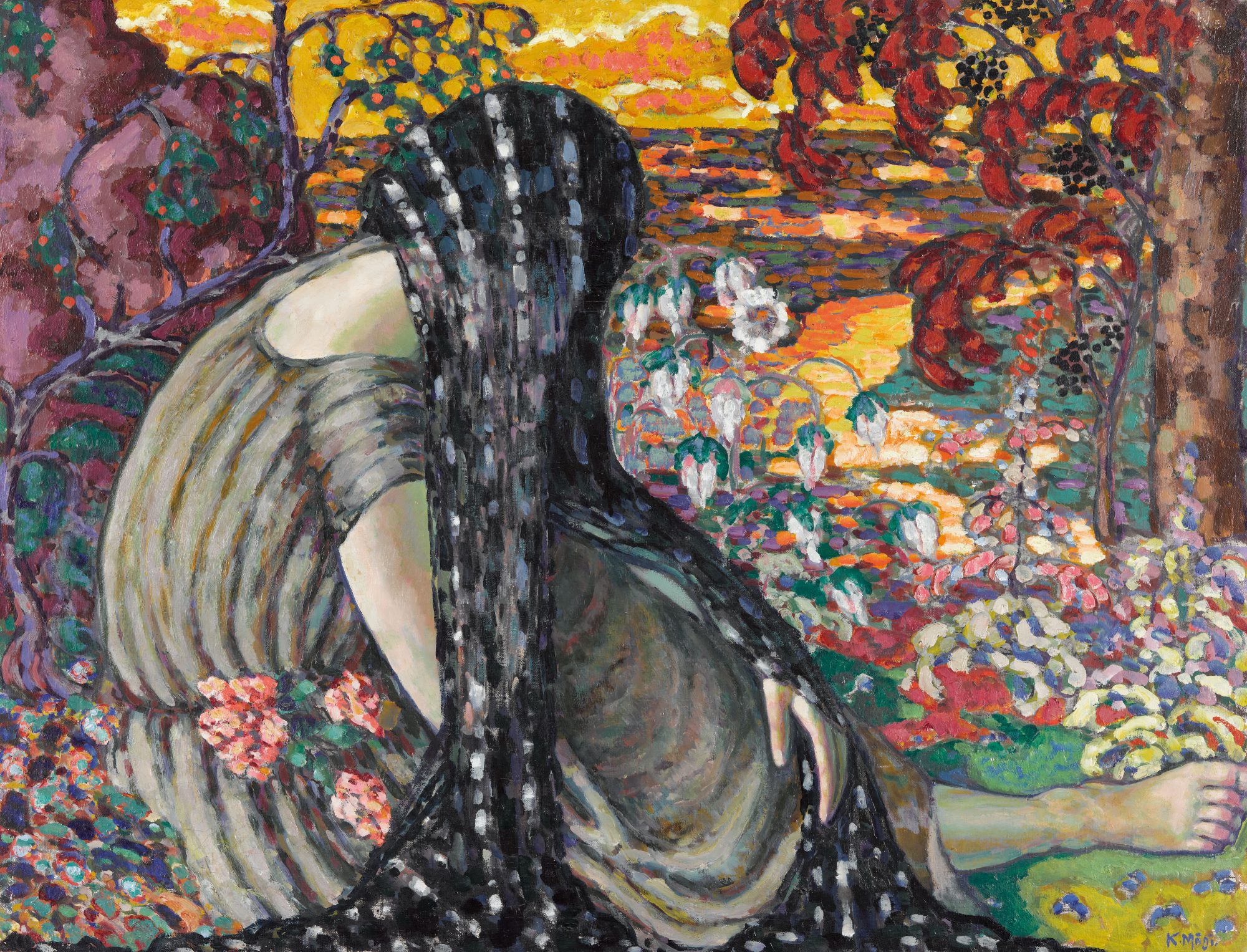
Meditation. (Landscape with a Lady)
This painting is the only example where Konrad Mägi has depicted a human figure in a non-portrait format. In other works, Mägi has incorporated human figures into a landscape or park motif, but in no other known works did he make a person the focus as he does in this work. So this is a rare example in his oeuvre, where he was not reacting directly to an external impulse but consciously constructed the painting’s motif.
Meditation dates to the years immediately following the Saaremaa summers, when Mägi was living and working in Tartu and Viljandi. On 20 July 1915, he sent Marie Reisik a letter in which he writes: “On top of everything there’s one thing that has come out very well for me, and it is something that I have always longed to do but never managed before, i.e., I have not even tried. It is a sketch for a Madonna. Of my current works, it is the one experiment that has come out best, most spiritual in colours and form.”[1] It isn’t known whether the letter is about this painting, because the work was exhibited only in 1917 under the name Panel. Meditation.
Edgar Allan Poe stories have also been considered to play a part in the origin of the painting. Artur Adson remembers: “In spring 1917, I bought from him [K. Mägi] at the Tallinn art exhibition the painting Meditation, which was supposed to have been painted based on a story by Edgar Allan Poe. It depicted a woman with a grey veil covering her head, bouquet of roses attached to her waist, in the middle of a very colour-filled landscape, and it hung on the wall of our Nõmme home until we fled the country.”[2] Since Adson and Under were good friends of Mägi’s, the comment about Poe may have been from Mägi himself.
Poe was said to be Mägi’s favourite author back then, but maybe Adson’s memory is imperfect and Mägi was influenced by Poe’s poems instead. Namely, Mägi’s young friend Johan Leppik wrote him: “I have a surprise for you: E. A. Poe’s songs with 28 colour illustrations by E. Dulac. I figured it would bring you happiness.” It was Dulac’s illustrations for Poe’s book The Bells and Other Poems (1912), where Dulac uses similar female figures in long black hair in a mysterious environment.
Another theory is that the female figure was a spiritual medium. We know that Mägi took part in séances in Helsinki and, back in Estonia, helped organize them. There is some indication that the esoteric arts were quite widespread in Tartu in the First World War years and had been imported from St. Petersburg by people fleeing war. The famous dancer Ella Ilbak, who befriended Mägi and often sat in his studio (Ilbak said being in Mägi’s company was always a jolly time and his works were “bold, fresh and had a great individuality”), took part in these séances as well.
The title of the painting however refers to Rudolf Steiner’s theosophy. In Steiner’s ideas, meditation is a key to experiencing a higher sphere that lies behind the visible world. Konrad Mägi first heard of Steiner’s ideas when he was in Norway. In spring 1909, Steiner delivered a lecture in Oslo on the connections between theosophy and apocalypse – it is not known whether Mägi attended. Some say Mägi may have even painted a portrait of Steiner, but no details about this exist.
As a literary parallel, Tõnis Tootsen brings out not Poe but Friedebert Tuglas’s story At the End of the World, which was published around the time of the painting’s completion, appearing in the Young Estonia magazine Vaba Sõna in 1915, and in 1916. In the novella, Tuglas painted a picture of an island inhabited by a giant virgin.
“She was everywhere I turned: in the trees, lake, meadows. The sky and earth were full of her. There wasn’t one of her, there was uncountably many, and she was everywhere. The lush grass was like her hair…”, writes Tuglas. The island is also characterized by very prolific, exotic flora. When the giant virgin starts showing her dark side, the plant life also changes: “Entire areas were covered with flowers, the gigantic blossom chalices were the colour of human skin. They broke underfoot and exposed their contents, which were bloody as raw meat…” Finally, the main character slays the woman and “her blood flowed on the sand, into the sea; I saw the water turn red”.
Tuglas also describes the silver threads woven into the virgin’s hair and the veil around her head. He also describes the virgin watching the sunset with other giants. It has been conjectured that Tuglas wrote the story with Marie Under in mind. The words “Giant Virgin’s letters” is written (probably in Elo Tuglas’s handwriting) on the wrapper of Under’s love letters to Tuglas.
If so, then Mägi has painted a work that is based on the love story of Tuglas and Under, the painting is bought by Under’s new companion as the work belonged to Marie Under and Artur Adson.
The painting hung in Adson and Under’s various homes, starting in 1933 in their house in the Rahumäe part of Tallinn. They did not take the painting with them when they left the country; it remained in the possession of Friedebert Tuglas, who moved into the same house, and through whom the painting was acquired by the Art Museum of Estonia in 1946.
Marie Under and Konrad Mägi interacted frequently, beyond just the context of this painting. Marie Under also mentions the painting in her home in a poem published in 1918:
A lamp – smaller rival to the bigger sun –
Is waiting on the table in the red glow of a silk dress.
And on the wall, Mägi’s painting revelling in colours:
A young woman, eyes covered, in reverent redemption.
(From the poetry collection Blue Sail, the cycle “Interiors”.)
[1] Quoted in Rudolf Paris’s monograph Konrad Mägi (1932), p. 170.
[2] A. Adson (ed.), Marie Underi eluraamat. Stockholm: Vaba Eesti, 1974, p. 65.
.jpg)
Norwegian Landscape
It is the largest of the known Norwegian paintings and the mountains in the distance could locate Mägi to the west of Oslo in a more mountainous area. Yet there are surprisingly few cliffs and mountains in his Norwegian works, considering how prominent they are there and how enraptured Mägi was by exotic landscape forms of Capri and in Oberstdorf, and even in southern Estonia where he focused on the hilly relief. “Just think: big blue mountains and red clouds roam quite high there. It got the feeling that it was precisely the place where the Gods might live,” Mägi gushed in Norway. Yet the mountains are largely omitted from his works and it is possible that even this work was not done in the true mountainous areas in the west but rather in the vicinity of Oslo.
The painting powerfully visualizes a number of the central positions of Mägi’s oeuvre: the emphasis on the metaphysical dimension, a pantheistic view of nature, with humankind and the works of man only secondary, a panoramic, epic view of the landscape. His signature style, however, is more constructed and less colourful here than, for example, in his later Saaremaa period. Also surprising is Mägi’s take on clouds. Meteorologist Jüri Kamenik argues that these cannot even be Norwegian clouds, as he says such heaps of cumulus clouds are not known to form in mountainous areas. He says that while the landscape is indeed Norwegian, the clouds are relicts of Mägi’s Estonia experience. By that time, he had been away from Estonia for six years and there are a number of different interpretations for why he returned to his childhood experiences through his paintings. It might have been a tactical move, as puffy piles of clouds are more dramatic than the strips of cloud characteristic of the Norwegian mountains and are better at evoking the theatrical sense of the sacral that fascinated Mägi. It could also have been a question of composition, as the clouds once seen in Estonia were better than Norwegian clouds at energizing the landscape and adding more emotional layers of meaning. Yet not to be overlooked is the interpretation that Mägi might have wanted to seek refuge in a home-like mental space, for he repeatedly wrote in his letters he felt stymied, lonely and in existential distress, and maybe clouds remembered from his childhood were a lifeline to peace, stability and sense of security.
Lake Pühajärv
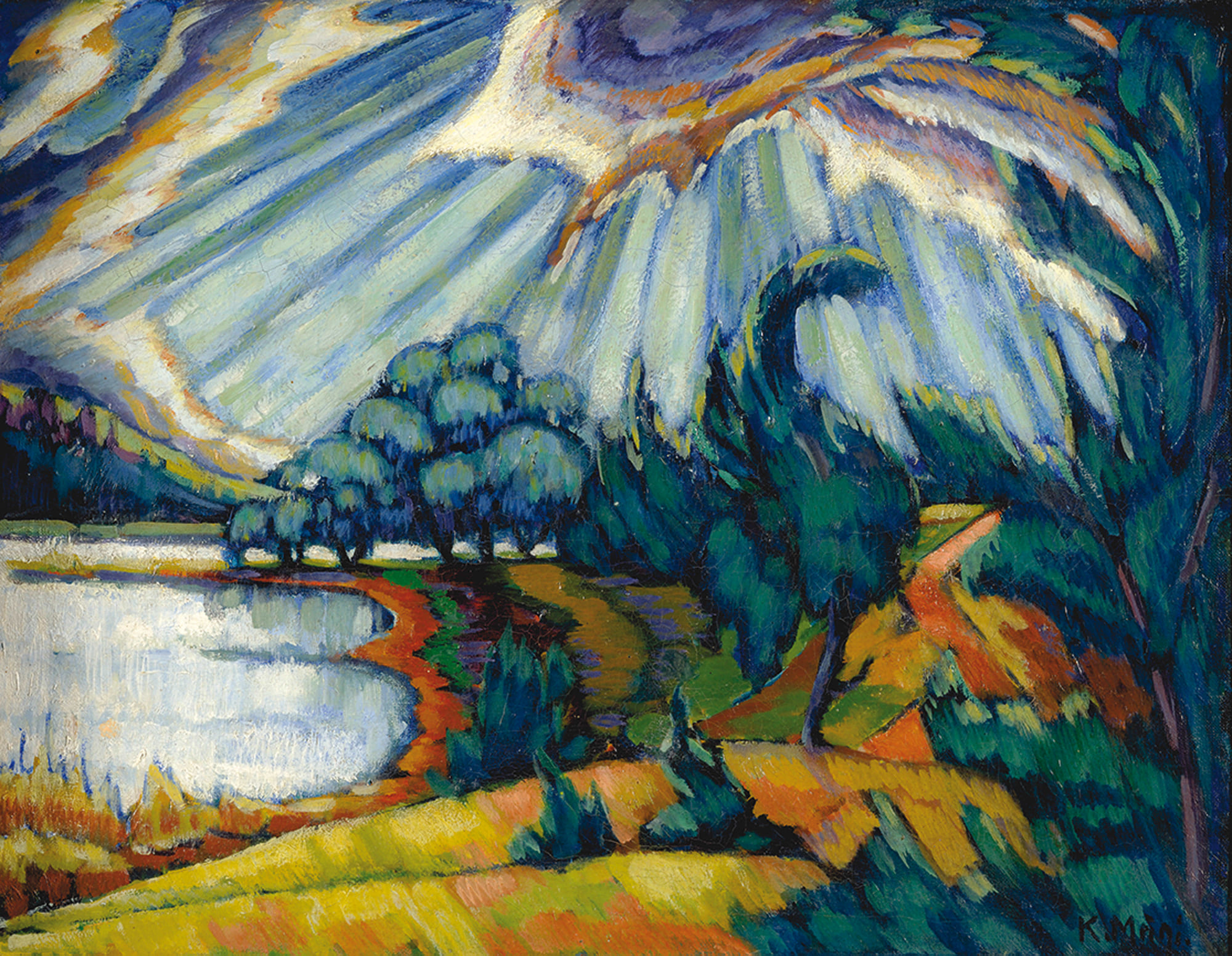
This painting could initially be confused with a realistic view of northern lights but it does not depict the aurora. While the resemblance is accurate, everything else here is consistent with the white nights of summer, a time when the northern lights are, of course, not visible. Until late August, the sky is too bright. There is also no record in the press of the northern lights being visible at Lake Pühajärv in those years.
Mägi fuses an idyllic and quite typical image of the lake, considered one of Estonia’s gems, with an extraordinarily dramatic, almost apocalyptic sky. Here again, there is a conflict between the calm decorative landscape and explosively writhing sky, albeit where the turmoil has little influence on what lies beneath it. Thus, the drama of this painting is not focused only on the celestial; in fact, the drama only occurs in the heavens.
In some sense, the painting can be seen as the culmination of Mägi’s sky observations. Even in his Norwegian period, he often focused special attention on the dramatic cloud motifs in order to express a metaphysical or sacral dimension. Largely due to Mägi’s way of depicting sky and clouds, there is a pantheistic sensibility here, with all of nature resonating with a religious dimension. For Mägi, this aspect meant not quiet harmony but sublimity. Mägi’s skies are often very moody, with outsize emotional impact, and the objective appears to be cathartic.
Lake Pühajärv
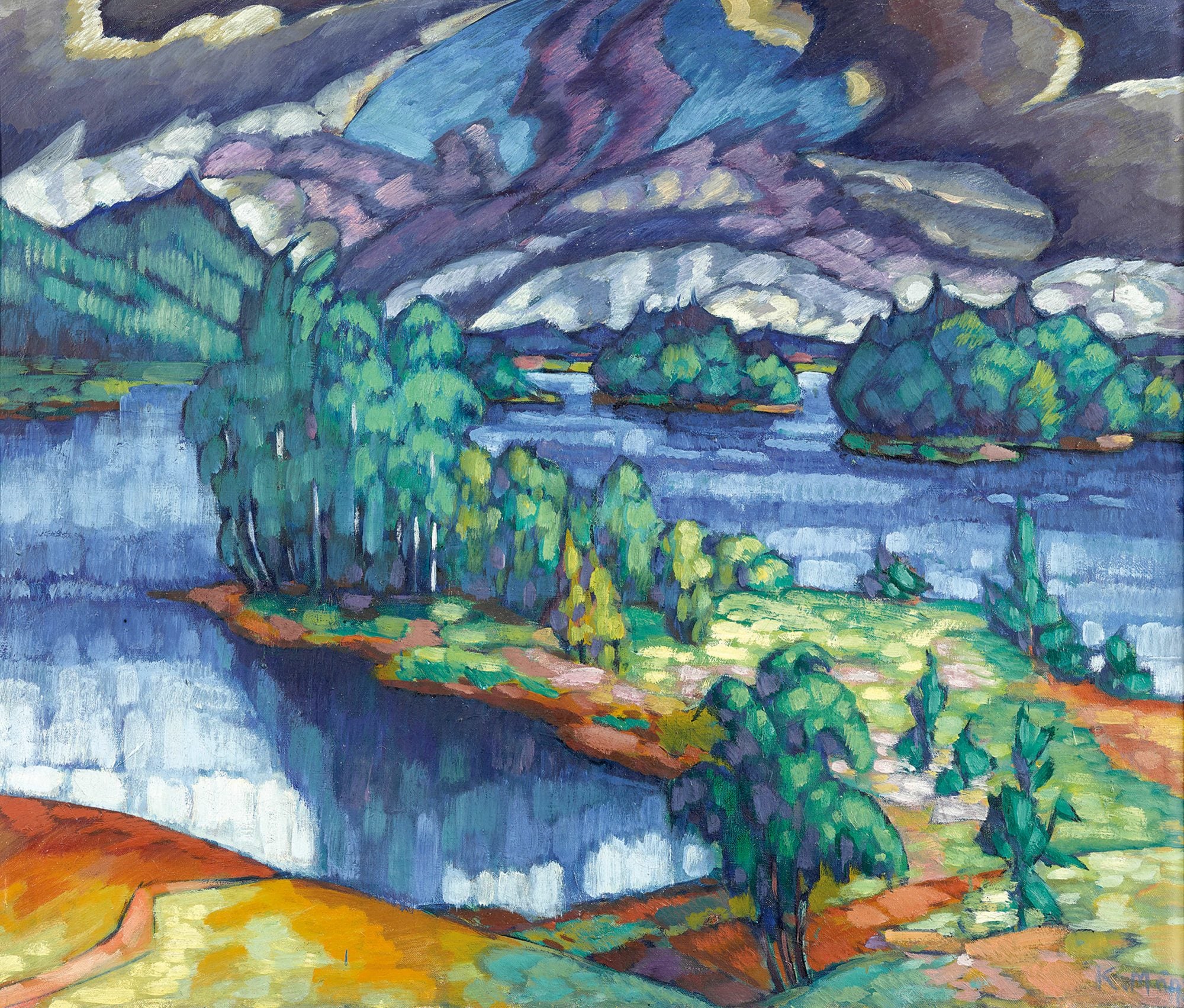
In the topography of Estonian cultural lore, Lake Pühajärv plays an important role in the early decades of the 20th century. A number of writers and artists spent the summers on the shores of the picturesque lake near the small southern Estonian town of Otepää. The first such summer was in 1918, when they rented Saare Farm’s new lakeside summer house on the southeast shore of the lake from April to the summer’s end. The holiday-makers were members of the Siuru literary group, and Konrad Mägi was among the guests who visited Lake Pühajärv. He produced many pencil sketches and later finished the paintings in his studio. Similarly to the writers, Mägi also visited the lake in the following summers. An inscription on the window alcove of the summer house’s attic stands in witness of this: “Marie Under, Arthur Adson, Friedebert Tuglas, August Gailit, Joh. Semper, Henrik Visnapuu, Aug. Alle, Konrad Mägi and Ado Vabbe stayed here 1918–1925”.
The tradition of depicting lakes was not uncommon either in the work of Mägi or in painting traditions of the late 19th century or early 20th century in general. In particular, there were many artists from the Nordic countries who made lakes the setting and central motif of their paintings. While Mägi’s oeuvre includes only a few works where a lake becomes the star of the painting (e.g., Lake Verijärv), the lake was often more central in the works by Nordic artists. Sometimes it is a setting; sometimes a romantic background; sometimes it serves identity politics goals, used to define a narrower social group or liken an entire nationality to nature. In Mägi’s paintings, the lake is generally a functional compositional element: its task is to imbue the landscape forms with rhythm and tone colour. Bluish patches of colour nestled in rolling low hills often have merely decorative or delineative value.
Yet Mägi’s consistency in depicting lakes cannot be overlooked. Besides Lake Pühajärv, he also painted the lakes Saadjärv, Valgjärv and Kasaritsa, and a number of smaller, anonymous bodies of water.
Otepää Landscape
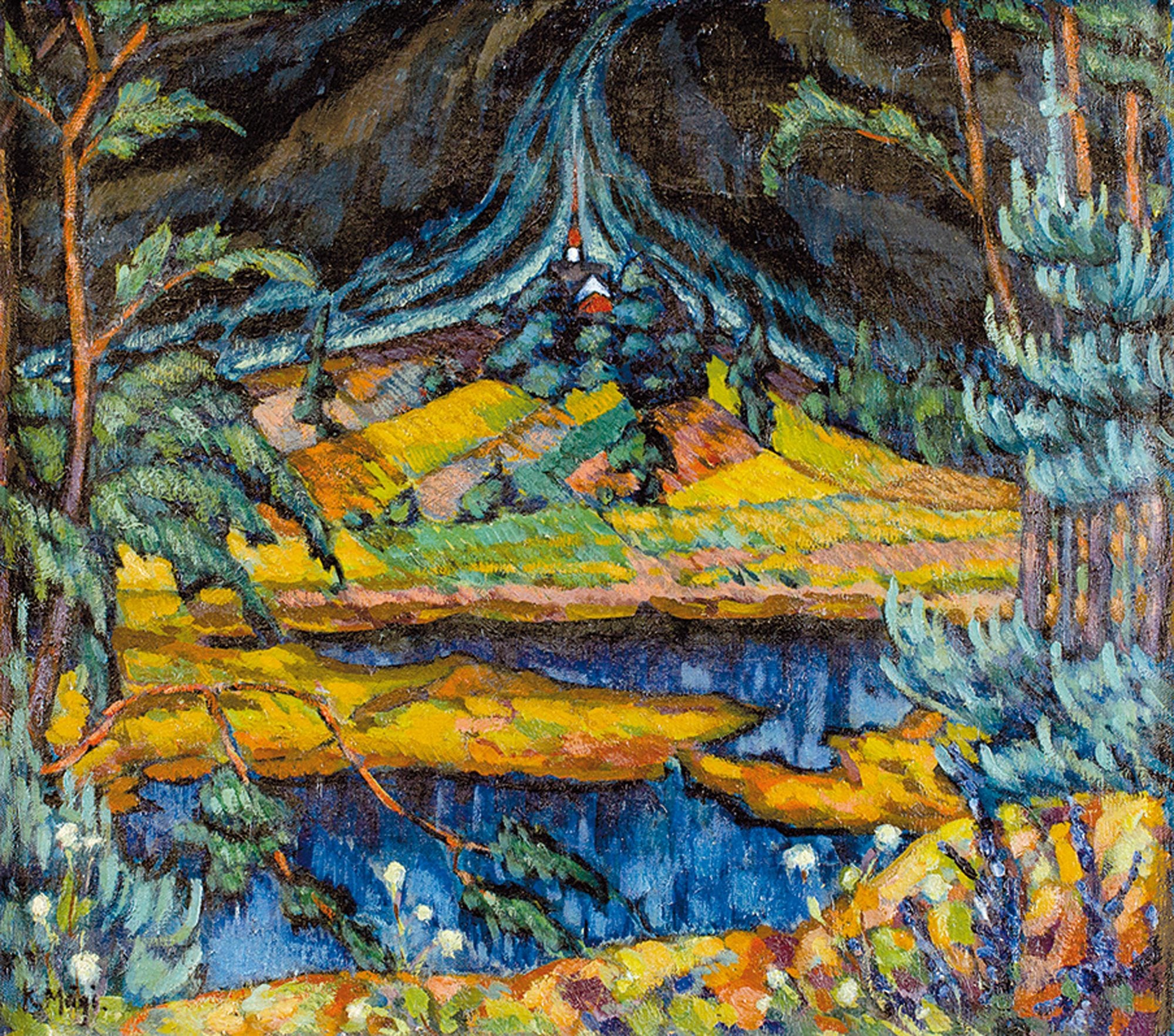
Painted on one of Konrad Mägi’s summer outings to Lake Pühajärv, this is one of his most visionary works. What we see in the sky on the painting cannot be reduced to any concrete meteorological phenomenon, as it is the product of the artist’s imagination, which despite being seemingly impulsive is actually carefully planned – it has been revealed that underneath the layers of paint, the vectors reaching skyward had originally started from a somewhat lower position.
This work can also be placed in the context of two Christian compositions painted in the same period: Kolgata (1921) and Pietà (1919, both now lost). Mägi chose the Crucifixion and Lamentation as the theme for these paintings. More broadly put, they both have in common the motifs of suffering, death, resurrection and ascension.
If we place Otepää Landscape with its trajectories of ascension next to the two giant compositions, we can see them as a mini-cycle. He proceeds from a Christian as well as pantheistic interpretation, in both cases a tie between the earthly and the celestial. But while Kolgata and Pietà view the ascension through the humanist perspective, placing the myth of human suffering, the principle of sin and redemption at the centre, then Otepää Landscape can be considered posthumanist. Ascension here is not related to humans but to a non-human plane. Nature and natural forces seek connection with the sky and the energy roiling there, which in some sense is the finale to Mägi’s treatment of landscape painting to this point, where he constantly sought to connect earth and sky. Mägi used very disparate means for doing so: reflections of the sky in the limpid lakelets, the fact that the horizon has been lowered to make more room for the clouds, the sun is not depicted as a discrete object but integrated to the changes taking place in the landscape.
Using these strategies, Mägi often proceeds from a striving for sublimity and Otepää Landscape, too, seeks a cathartic experience. The darkened sky leaves no doubt that Mägi sees this scene as apocalyptic, not lyrical, but epic destruction is for him just as cathartic as the experience of Christ’s ascension.
Saaremaa Landscape
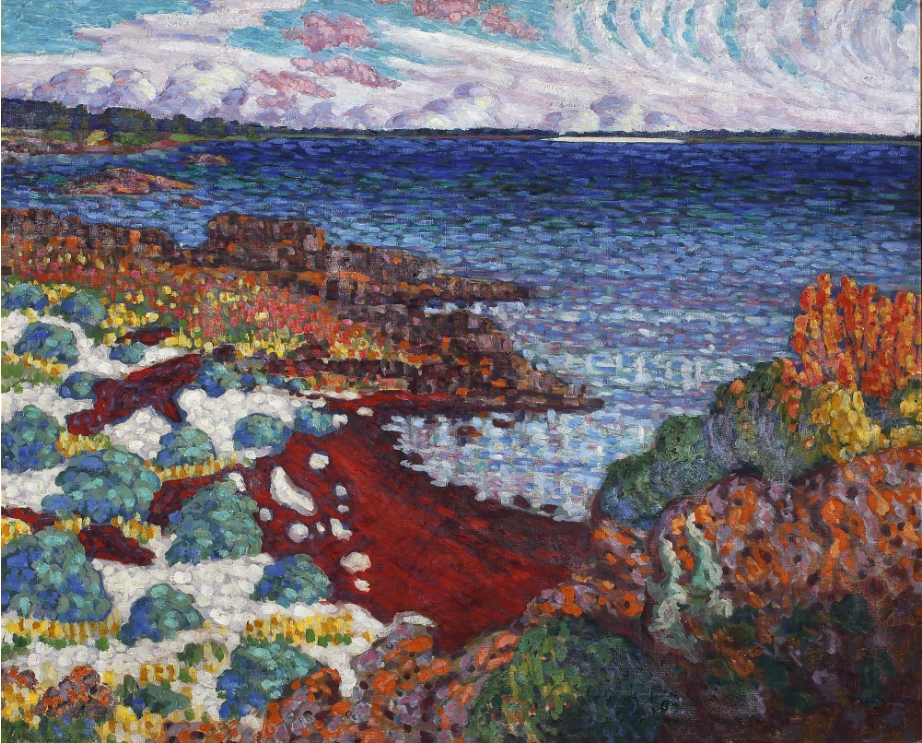
The work depicts the place Konrad Mägi painted the most often at the foot of Vilsandi Lighthouse looking south. On the left edge of the work, we see the setting of Sea Kale and Saaremaa. A Study, but several other paintings depicting the Vilsandi Lighthouse and flora in the area were also painted here.
Such intense attention given to one place is noteworthy. Mägi moves all of a few hundred metres in all these paintings, constantly changing viewpoints. He paints from close up and from afar, from the sea and from the land, from north to south and south to north, west to east as well. He feverishly revolves around one place, focusing by turns on the impressive botanical treasury and rich colour spectrum of the location, and – as on this painting – withdraws and uses a more panoramic perspective, which in a few years would become predominant in his southern Estonian paintings.
This is one of the largest of Mägi’s Saaremaa-themed works and its refinement raises the question of whether it may have been painted in a Tartu studio instead of on location. This idea is supported by the existence of a painted preliminary work, which may have been on site, since it is much more spontaneous and inchoate.
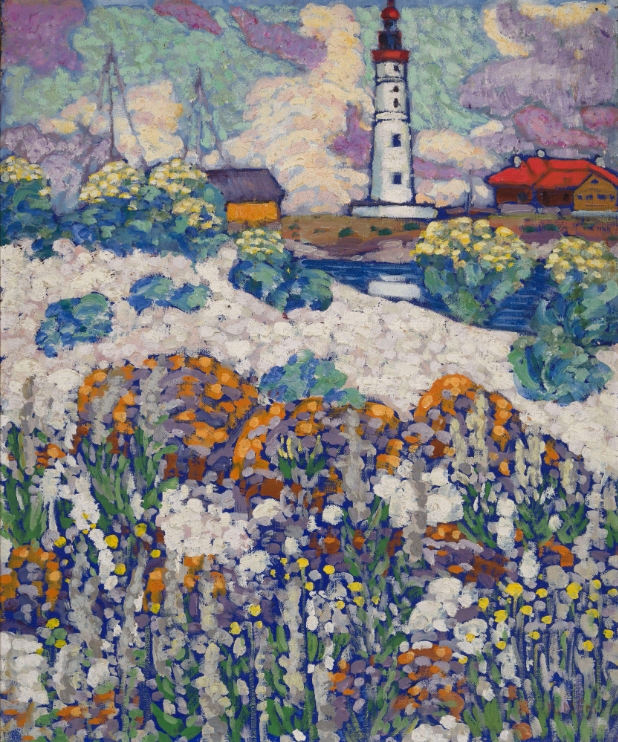
Lighthouse on Vilsandi
Vilsandi Lighthouse is probably the object that Konrad Mägi depicted most often – we know of six paintings where the white and red lighthouse has been featured from different angles. Mägi painted the lighthouse both from a position next to it on Vilsandi and also gazing at it from sea, from the Vaika Islands.
Yet the main event of the painting – as for many paintings in his Saaremaa cycle – is the flora: all of Mägi’s work is characterized by programmatic disregard for people in landscapes – there are only a few where humans are depicted in some way among his several hundred known works, and mostly they are an abstract and anonymous bloc of stripes of colour, not subjects with active agency. We never see any animals in his works (other than three tiny horses in the backdrop of Kolgata) and thus we can summarize by saying that the main objects depicted in Mägi’s nature paintings are small lakes, stones on Saaremaa, and ubiquitous flora – trees, shrubs, lichens, flowers, hay.
Mägi is not interested in botanical accuracy, nor does he bring any narrative approach to vegetation or ascribe to the miniature plant forms such as lichens, sea kale and flowers any special potential to speak to us in nuanced fashion about the natural world. It is hard to see Mägi’s depictions of flora as making any comment on national identity; as Saaremaa had not become a visual byword for Estonia as a whole, the insular plant life of Saaremaa would have been a bit alien to the national identity.
Mägi’s fondness for plants would not return in quite such an intimate and emotional form. Later on, he painted plants in a much more distanced and generalized manner: bushes in the distance, decorative tree trunks and so on. Flower blossoms on his paintings are generally detached from nature; placed in a vase or adorning a portrait of some lady. The wild botanical abandon of Lighthouse on Vilsandi appears to spring first and foremost from the aesthetic value of the plants: the colourfulness of Vilsandi’s flora on the microscopic level is truly extremely spectacular.
Yet the teeming baroque luxuriance of the plant life on this painting can also evoke pulsating vitality. Small plants pushing through the scree have taken over the entire seashore. The unchecked advance of such plants might have struck Mägi as mystical, perhaps exotic, because feeling such a strong will to live – almost an urge – might have been an unfamiliar notion for him. This painting can however be considered linked even to Mägi’s later Christian compositions depicting the descent from the cross and where he dealt with the idea of rebirth and eternal life: Mägi was probably drawn equally by the mysteries of both life and death.
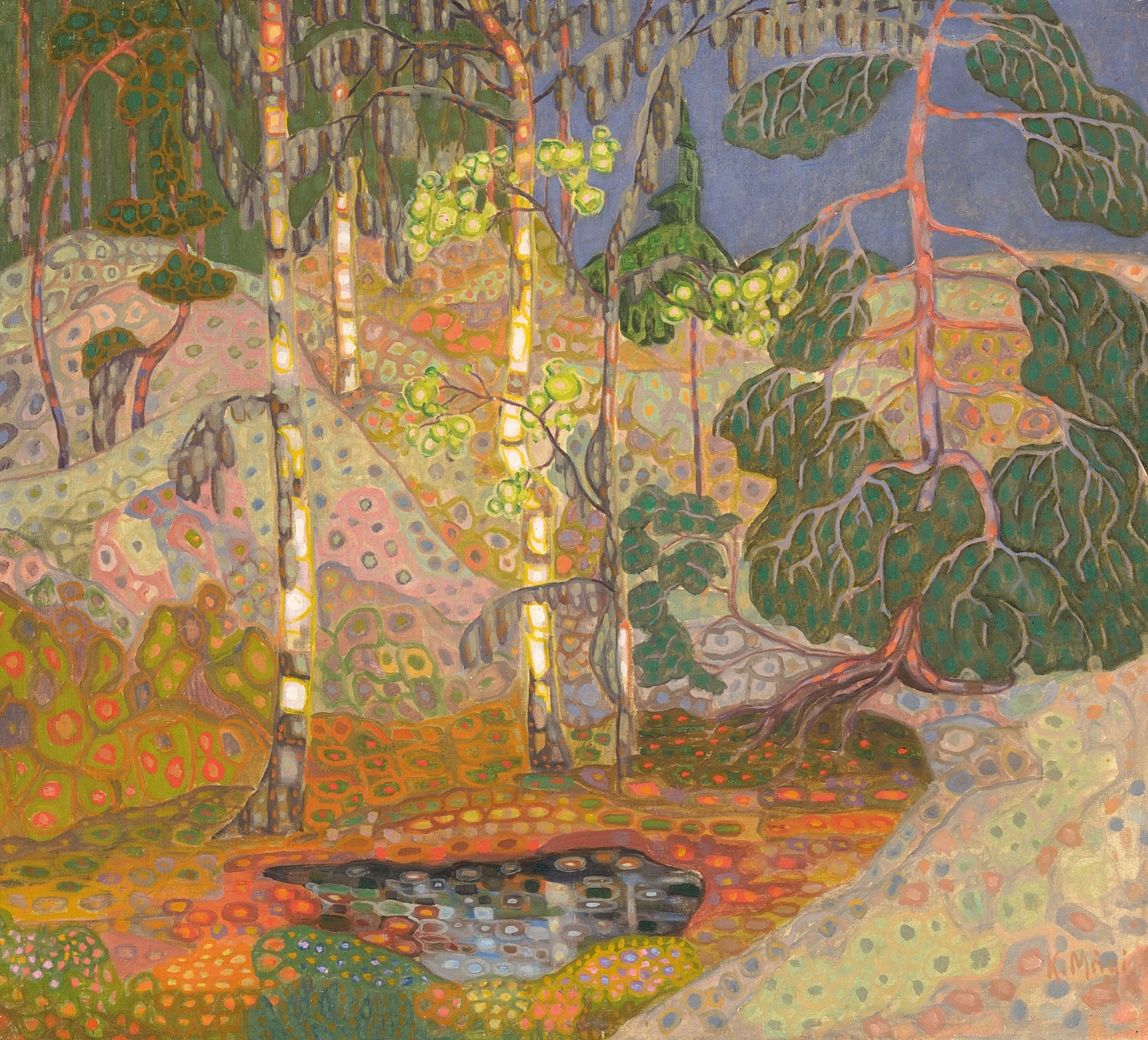
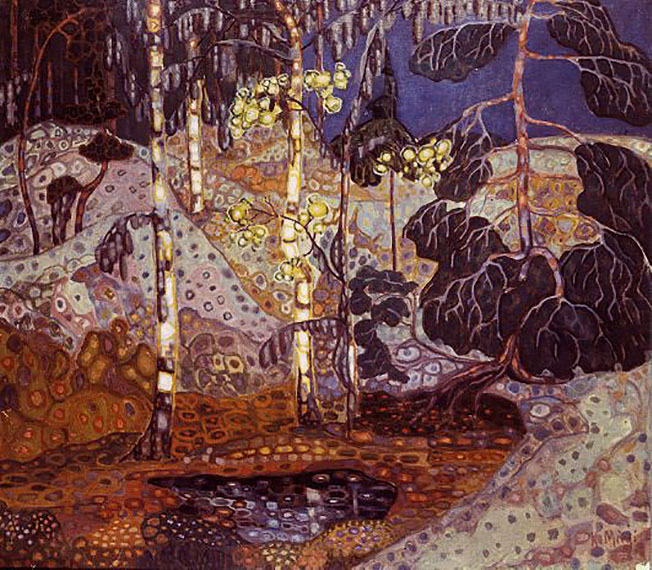
Norwegian Landscape. Bog Landscape
The bog motif is not uncommon in Estonian folklore, as it also meant a place to hide. But in the fine arts, wetland themes are rare and Mägi’s foray into this theme in Norway was a one-off, as he generally depicted lush and fertile vegetation, not relatively barren bogs and mires. It is not known why Mägi depicted a wetland in Norway. But there is an interesting parallel with a poem written by Gustav Suits in 1908.
Out on the Bog Ponds
The bogs are brimming with deep ponds.
Is the water, so dark and voiceless, rusty
Or is it the pain looking up from underground, full of wild blackness?
The bogs are brimming with deep ponds.
Bubbles rise up through the water all silvery.
Oh yearnings, secret desires within the mires,
Oh dreams that suddenly vanish into nothingness!
Bubbles rise up through the water all silvery.
The dwarf birch is gnarled, bent over to the ground.
The deceptive peaty sod shifting underfoot,
With stagnant flows buried in mud.
The dwarf birch is gnarled, bent over to the ground.
A thousand mosquitoes press forward across the mires.
They fall on to the face, into the mouth, they suck into the blood,
They penetrate the will, they creep into the heart.
A thousand mosquitoes press forward across the mires.
Comparing it to Mägi’s painting, we see a number of parallels on the visual level as the painting has a number of birches and silvery bubbles rising from a dark bog pond. There are also parallels in the way the bog has been associated with visionary, dream-like, indefinite states, where forms change and there is no firm footing to be felt. The synchronous appearance of bog themes in modern Estonian literature and art and the resulting mystification of nature is noteworthy and may signal a certain generational attitude that is sustained by nature and related folklore but also makes them a sounding-board for personal psychological tensions and a proving ground for modern searches for form.
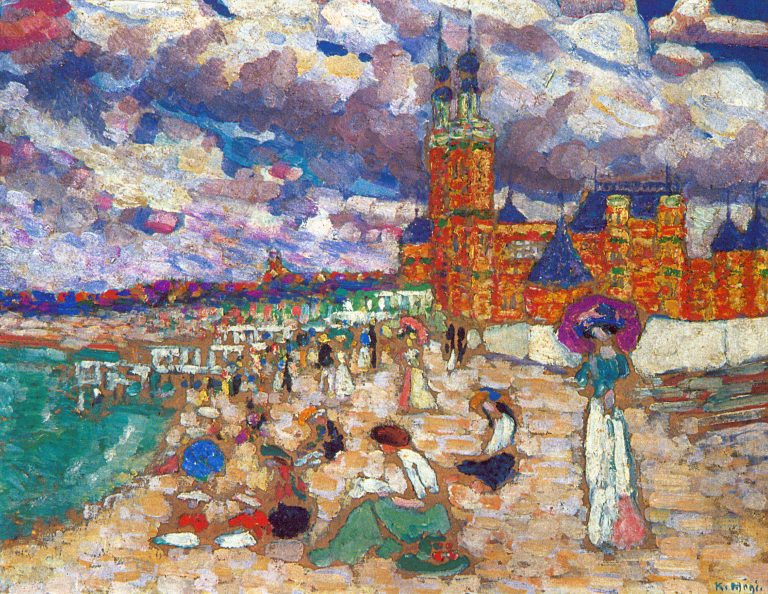
Dieppe Beach with a Cathedral
Young Rom
As with the Romani girl, Konrad Mägi also probably painted this portrait of a young Romani man in the late winter of 1915 in Viljandi, (see Romani Girl, Art Museum of Estonia). Unlike the girl, the man is of Russian origin, as he is not as dark-complexioned as the girl. He, too, appears to be from the upper echelons of Romani society, as indicated above all by his costly blazer. Zalina Dabla, the chairwoman of the Estonian Roma, says this may even signify that the model is the chieftain’s son. The head covering is a usual part of Romani sartorial culture; his moustache is a cultural norm, as it distinguished a man from a boy and was a symbol of masculinity and never shaved off. The tapestry behind his back is not hand-woven but a wall covering from Russia with a fairly ordinary pattern.
The painting is from the First World War era when many Roma fought in the tsarist army. As a result, they had a relatively good reputation and the state gave them horses as a token of gratitude. It is impossible to determine whether this particular man’s wealth could have been due to services rendered in the war.
Portrait of a Norwegian Girl
On 9 June 1910, Konrad Mägi wrote his friend and agent, Eduard Virgo, who was working as a journalist then: “As for my pictures in Helsinki, there are so many bad ones that I can’t exhibit, only perhaps sell privately. For example, there are some landscapes and the picture of a girl’s face in the larger folder. They can’t be put out on display, because as far as I remember, they are very poor.” It is possible that the picture of the girl’s face Mägi was disparaging was the Portrait of a Norwegian Girl, which is now one of his best-known works.
The model is believed to be the 14-year-old daughter of the Norwegian politician Adam Egede-Nissen. Her name was Gerdi and later, as Gerdi Grieg, she would be a famous star of the screen and stage. Egede-Nissen, the father, was a well-known politician, elected to parliament on the vote of the fishing community in the north of the country. Due to his left-wing views (he later founded the Norwegian Communist Party) had close interactions with Russian emigrants, a group with which Mägi also socialized – and virtually belonged to. Egede-Nissen, a supporter of Lenin (and later, Stalin as well), was an extremely friendly and warm person who always tried to help those in a weaker position than he; he also had Mägi over for dinner many times. At these meals, they almost certainly talked politics, too.
The red colour in the work may have also been a reference to the father’s political views, yet Mägi made heavy use of that colour throughout the Norwegian period (see e.g., Norwegian Landscape with a Pine Tree) and so this particular painting does not stand out. It has been written in a memoir that Mägi later asked a girl to pose and “he was interested in my reddish hair.”
The background deserves attention – the ornamental background became a predominant feature in Mägi’s portraits – as does the girl’s hair. They are reminiscent of a labyrinth; the girl’s white collar and tapestry also are like intricate arabesques. Depiction of abstract labyrinths in women’s hair (including in paintings by Edvard Munch and Gustav Klimt) was a way of symbolizing mystical unworldly power, but Munch and Klimt also imbued it with a strong erotic charge. While the model in Mägi’s painting is not sexualized, the work is the most psychological portrait by Mägi, as he would subsequently prettify and idealize his models
Norwegian Landscape with Pine is almost psychedelic in style. Photo: Stanislav Stepashko
Norwegian Landscape with a Pine Tree
The Norwegian landscapes are generally undated, but it is hard to believe that he would have immediately started with such sweeping, grand paintings as these in his first creative period. It seems more logical that the smaller, more impulsive and laconic paintings were from the second half of 1908 and from 1909, while the bigger ones are from 1909 or 1910.
Today we know that Mägi worked mainly inland – mainly around Oslo, but also travelling to the east. There are reports that he painted in Eidskog Municipality– near the Swedish border – in summer 1910, about 80 kilometres from Oslo as the bird flies, in the small town of Skotterud. On 9 June 1910, he writes: “I am now practically in the countryside. Nature does not offer that much; the air is a little strained but living here at least is cheap.”
It is not impossible that Mägi was invited to Eidskog by Norwegian painter Erik Werenskiold, who was from there and born in Skotterud. They may have met through the fact that Werenskiold’s sister-in-law was married to the uncle of Norwegian politician Adam Egede-Nissen, and Mägi painted a portrait of Egede-Nissen’s daughter. The possible contact with Werenskiold is nevertheless speculative, there is no evidence of it and or even traces that Werenskiold’s work influenced Mägi.
Norway is the only place where Mägi apparently painted bog landscapes. His childhood home was not in a wetland area, and it is also unlikely that he had experienced bogs in St. Petersburg, the Åland Islands or Paris.
On both paintings with bog motifs, Mägi emphasized a certain dream-like, psychedelic quality that could in turn be associated with the stories from Estonian folklore about the mysterious and supernatural character of bogs, of the will-o’-the-wisp, intoxicating vapours, spirits that lead travellers astray, monsters and so on.
Meditation. (Landscape with a Lady)
This painting is the only example where Konrad Mägi has depicted a human figure in a non-portrait format. In other works, Mägi has incorporated human figures into a landscape or park motif, but in no other known works did he make a person the focus as he does in this work. So this is a rare example in his oeuvre, where he was not reacting directly to an external impulse but consciously constructed the painting’s motif.
Meditation dates to the years immediately following the Saaremaa summers, when Mägi was living and working in Tartu and Viljandi. On 20 July 1915, he sent Marie Reisik a letter in which he writes: “On top of everything there’s one thing that has come out very well for me, and it is something that I have always longed to do but never managed before, i.e., I have not even tried. It is a sketch for a Madonna. Of my current works, it is the one experiment that has come out best, most spiritual in colours and form.”[1] It isn’t known whether the letter is about this painting, because the work was exhibited only in 1917 under the name Panel. Meditation.
Edgar Allan Poe stories have also been considered to play a part in the origin of the painting. Artur Adson remembers: “In spring 1917, I bought from him [K. Mägi] at the Tallinn art exhibition the painting Meditation, which was supposed to have been painted based on a story by Edgar Allan Poe. It depicted a woman with a grey veil covering her head, bouquet of roses attached to her waist, in the middle of a very colour-filled landscape, and it hung on the wall of our Nõmme home until we fled the country.”[2] Since Adson and Under were good friends of Mägi’s, the comment about Poe may have been from Mägi himself.
Poe was said to be Mägi’s favourite author back then, but maybe Adson’s memory is imperfect and Mägi was influenced by Poe’s poems instead. Namely, Mägi’s young friend Johan Leppik wrote him: “I have a surprise for you: E. A. Poe’s songs with 28 colour illustrations by E. Dulac. I figured it would bring you happiness.” It was Dulac’s illustrations for Poe’s book The Bells and Other Poems (1912), where Dulac uses similar female figures in long black hair in a mysterious environment.
Another theory is that the female figure was a spiritual medium. We know that Mägi took part in séances in Helsinki and, back in Estonia, helped organize them. There is some indication that the esoteric arts were quite widespread in Tartu in the First World War years and had been imported from St. Petersburg by people fleeing war. The famous dancer Ella Ilbak, who befriended Mägi and often sat in his studio (Ilbak said being in Mägi’s company was always a jolly time and his works were “bold, fresh and had a great individuality”), took part in these séances as well.
The title of the painting however refers to Rudolf Steiner’s theosophy. In Steiner’s ideas, meditation is a key to experiencing a higher sphere that lies behind the visible world. Konrad Mägi first heard of Steiner’s ideas when he was in Norway. In spring 1909, Steiner delivered a lecture in Oslo on the connections between theosophy and apocalypse – it is not known whether Mägi attended. Some say Mägi may have even painted a portrait of Steiner, but no details about this exist.
As a literary parallel, Tõnis Tootsen brings out not Poe but Friedebert Tuglas’s story At the End of the World, which was published around the time of the painting’s completion, appearing in the Young Estonia magazine Vaba Sõna in 1915, and in 1916. In the novella, Tuglas painted a picture of an island inhabited by a giant virgin.
“She was everywhere I turned: in the trees, lake, meadows. The sky and earth were full of her. There wasn’t one of her, there was uncountably many, and she was everywhere. The lush grass was like her hair…”, writes Tuglas. The island is also characterized by very prolific, exotic flora. When the giant virgin starts showing her dark side, the plant life also changes: “Entire areas were covered with flowers, the gigantic blossom chalices were the colour of human skin. They broke underfoot and exposed their contents, which were bloody as raw meat…” Finally, the main character slays the woman and “her blood flowed on the sand, into the sea; I saw the water turn red”.
Tuglas also describes the silver threads woven into the virgin’s hair and the veil around her head. He also describes the virgin watching the sunset with other giants. It has been conjectured that Tuglas wrote the story with Marie Under in mind. The words “Giant Virgin’s letters” is written (probably in Elo Tuglas’s handwriting) on the wrapper of Under’s love letters to Tuglas.
If so, then Mägi has painted a work that is based on the love story of Tuglas and Under, the painting is bought by Under’s new companion as the work belonged to Marie Under and Artur Adson.
The painting hung in Adson and Under’s various homes, starting in 1933 in their house in the Rahumäe part of Tallinn. They did not take the painting with them when they left the country; it remained in the possession of Friedebert Tuglas, who moved into the same house, and through whom the painting was acquired by the Art Museum of Estonia in 1946.
Marie Under and Konrad Mägi interacted frequently, beyond just the context of this painting. Marie Under also mentions the painting in her home in a poem published in 1918:
A lamp – smaller rival to the bigger sun –
Is waiting on the table in the red glow of a silk dress.
And on the wall, Mägi’s painting revelling in colours:
A young woman, eyes covered, in reverent redemption.
(From the poetry collection Blue Sail, the cycle “Interiors”.)
[1] Quoted in Rudolf Paris’s monograph Konrad Mägi (1932), p. 170.
[2] A. Adson (ed.), Marie Underi eluraamat. Stockholm: Vaba Eesti, 1974, p. 65.
Norwegian Landscape
It is the largest of the known Norwegian paintings and the mountains in the distance could locate Mägi to the west of Oslo in a more mountainous area. Yet there are surprisingly few cliffs and mountains in his Norwegian works, considering how prominent they are there and how enraptured Mägi was by exotic landscape forms of Capri and in Oberstdorf, and even in southern Estonia where he focused on the hilly relief. “Just think: big blue mountains and red clouds roam quite high there. It got the feeling that it was precisely the place where the Gods might live,” Mägi gushed in Norway. Yet the mountains are largely omitted from his works and it is possible that even this work was not done in the true mountainous areas in the west but rather in the vicinity of Oslo.
The painting powerfully visualizes a number of the central positions of Mägi’s oeuvre: the emphasis on the metaphysical dimension, a pantheistic view of nature, with humankind and the works of man only secondary, a panoramic, epic view of the landscape. His signature style, however, is more constructed and less colourful here than, for example, in his later Saaremaa period. Also surprising is Mägi’s take on clouds. Meteorologist Jüri Kamenik argues that these cannot even be Norwegian clouds, as he says such heaps of cumulus clouds are not known to form in mountainous areas. He says that while the landscape is indeed Norwegian, the clouds are relicts of Mägi’s Estonia experience. By that time, he had been away from Estonia for six years and there are a number of different interpretations for why he returned to his childhood experiences through his paintings. It might have been a tactical move, as puffy piles of clouds are more dramatic than the strips of cloud characteristic of the Norwegian mountains and are better at evoking the theatrical sense of the sacral that fascinated Mägi. It could also have been a question of composition, as the clouds once seen in Estonia were better than Norwegian clouds at energizing the landscape and adding more emotional layers of meaning. Yet not to be overlooked is the interpretation that Mägi might have wanted to seek refuge in a home-like mental space, for he repeatedly wrote in his letters he felt stymied, lonely and in existential distress, and maybe clouds remembered from his childhood were a lifeline to peace, stability and sense of security.
Lake Pühajärv
This painting could initially be confused with a realistic view of northern lights but it does not depict the aurora. While the resemblance is accurate, everything else here is consistent with the white nights of summer, a time when the northern lights are, of course, not visible. Until late August, the sky is too bright. There is also no record in the press of the northern lights being visible at Lake Pühajärv in those years.
Mägi fuses an idyllic and quite typical image of the lake, considered one of Estonia’s gems, with an extraordinarily dramatic, almost apocalyptic sky. Here again, there is a conflict between the calm decorative landscape and explosively writhing sky, albeit where the turmoil has little influence on what lies beneath it. Thus, the drama of this painting is not focused only on the celestial; in fact, the drama only occurs in the heavens.
In some sense, the painting can be seen as the culmination of Mägi’s sky observations. Even in his Norwegian period, he often focused special attention on the dramatic cloud motifs in order to express a metaphysical or sacral dimension. Largely due to Mägi’s way of depicting sky and clouds, there is a pantheistic sensibility here, with all of nature resonating with a religious dimension. For Mägi, this aspect meant not quiet harmony but sublimity. Mägi’s skies are often very moody, with outsize emotional impact, and the objective appears to be cathartic.
Lake Pühajärv
In the topography of Estonian cultural lore, Lake Pühajärv plays an important role in the early decades of the 20th century. A number of writers and artists spent the summers on the shores of the picturesque lake near the small southern Estonian town of Otepää. The first such summer was in 1918, when they rented Saare Farm’s new lakeside summer house on the southeast shore of the lake from April to the summer’s end. The holiday-makers were members of the Siuru literary group, and Konrad Mägi was among the guests who visited Lake Pühajärv. He produced many pencil sketches and later finished the paintings in his studio. Similarly to the writers, Mägi also visited the lake in the following summers. An inscription on the window alcove of the summer house’s attic stands in witness of this: “Marie Under, Arthur Adson, Friedebert Tuglas, August Gailit, Joh. Semper, Henrik Visnapuu, Aug. Alle, Konrad Mägi and Ado Vabbe stayed here 1918–1925”.
The tradition of depicting lakes was not uncommon either in the work of Mägi or in painting traditions of the late 19th century or early 20th century in general. In particular, there were many artists from the Nordic countries who made lakes the setting and central motif of their paintings. While Mägi’s oeuvre includes only a few works where a lake becomes the star of the painting (e.g., Lake Verijärv), the lake was often more central in the works by Nordic artists. Sometimes it is a setting; sometimes a romantic background; sometimes it serves identity politics goals, used to define a narrower social group or liken an entire nationality to nature. In Mägi’s paintings, the lake is generally a functional compositional element: its task is to imbue the landscape forms with rhythm and tone colour. Bluish patches of colour nestled in rolling low hills often have merely decorative or delineative value.
Yet Mägi’s consistency in depicting lakes cannot be overlooked. Besides Lake Pühajärv, he also painted the lakes Saadjärv, Valgjärv and Kasaritsa, and a number of smaller, anonymous bodies of water.
Otepää Landscape
Painted on one of Konrad Mägi’s summer outings to Lake Pühajärv, this is one of his most visionary works. What we see in the sky on the painting cannot be reduced to any concrete meteorological phenomenon, as it is the product of the artist’s imagination, which despite being seemingly impulsive is actually carefully planned – it has been revealed that underneath the layers of paint, the vectors reaching skyward had originally started from a somewhat lower position.
This work can also be placed in the context of two Christian compositions painted in the same period: Kolgata (1921) and Pietà (1919, both now lost). Mägi chose the Crucifixion and Lamentation as the theme for these paintings. More broadly put, they both have in common the motifs of suffering, death, resurrection and ascension.
If we place Otepää Landscape with its trajectories of ascension next to the two giant compositions, we can see them as a mini-cycle. He proceeds from a Christian as well as pantheistic interpretation, in both cases a tie between the earthly and the celestial. But while Kolgata and Pietà view the ascension through the humanist perspective, placing the myth of human suffering, the principle of sin and redemption at the centre, then Otepää Landscape can be considered posthumanist. Ascension here is not related to humans but to a non-human plane. Nature and natural forces seek connection with the sky and the energy roiling there, which in some sense is the finale to Mägi’s treatment of landscape painting to this point, where he constantly sought to connect earth and sky. Mägi used very disparate means for doing so: reflections of the sky in the limpid lakelets, the fact that the horizon has been lowered to make more room for the clouds, the sun is not depicted as a discrete object but integrated to the changes taking place in the landscape.
Using these strategies, Mägi often proceeds from a striving for sublimity and Otepää Landscape, too, seeks a cathartic experience. The darkened sky leaves no doubt that Mägi sees this scene as apocalyptic, not lyrical, but epic destruction is for him just as cathartic as the experience of Christ’s ascension.
Saaremaa Landscape
The work depicts the place Konrad Mägi painted the most often at the foot of Vilsandi Lighthouse looking south. On the left edge of the work, we see the setting of Sea Kale and Saaremaa. A Study, but several other paintings depicting the Vilsandi Lighthouse and flora in the area were also painted here.
Such intense attention given to one place is noteworthy. Mägi moves all of a few hundred metres in all these paintings, constantly changing viewpoints. He paints from close up and from afar, from the sea and from the land, from north to south and south to north, west to east as well. He feverishly revolves around one place, focusing by turns on the impressive botanical treasury and rich colour spectrum of the location, and – as on this painting – withdraws and uses a more panoramic perspective, which in a few years would become predominant in his southern Estonian paintings.
This is one of the largest of Mägi’s Saaremaa-themed works and its refinement raises the question of whether it may have been painted in a Tartu studio instead of on location. This idea is supported by the existence of a painted preliminary work, which may have been on site, since it is much more spontaneous and inchoate.
Lighthouse on Vilsandi
Vilsandi Lighthouse is probably the object that Konrad Mägi depicted most often – we know of six paintings where the white and red lighthouse has been featured from different angles. Mägi painted the lighthouse both from a position next to it on Vilsandi and also gazing at it from sea, from the Vaika Islands.
Yet the main event of the painting – as for many paintings in his Saaremaa cycle – is the flora: all of Mägi’s work is characterized by programmatic disregard for people in landscapes – there are only a few where humans are depicted in some way among his several hundred known works, and mostly they are an abstract and anonymous bloc of stripes of colour, not subjects with active agency. We never see any animals in his works (other than three tiny horses in the backdrop of Kolgata) and thus we can summarize by saying that the main objects depicted in Mägi’s nature paintings are small lakes, stones on Saaremaa, and ubiquitous flora – trees, shrubs, lichens, flowers, hay.
Mägi is not interested in botanical accuracy, nor does he bring any narrative approach to vegetation or ascribe to the miniature plant forms such as lichens, sea kale and flowers any special potential to speak to us in nuanced fashion about the natural world. It is hard to see Mägi’s depictions of flora as making any comment on national identity; as Saaremaa had not become a visual byword for Estonia as a whole, the insular plant life of Saaremaa would have been a bit alien to the national identity.
Mägi’s fondness for plants would not return in quite such an intimate and emotional form. Later on, he painted plants in a much more distanced and generalized manner: bushes in the distance, decorative tree trunks and so on. Flower blossoms on his paintings are generally detached from nature; placed in a vase or adorning a portrait of some lady. The wild botanical abandon of Lighthouse on Vilsandi appears to spring first and foremost from the aesthetic value of the plants: the colourfulness of Vilsandi’s flora on the microscopic level is truly extremely spectacular.
Yet the teeming baroque luxuriance of the plant life on this painting can also evoke pulsating vitality. Small plants pushing through the scree have taken over the entire seashore. The unchecked advance of such plants might have struck Mägi as mystical, perhaps exotic, because feeling such a strong will to live – almost an urge – might have been an unfamiliar notion for him. This painting can however be considered linked even to Mägi’s later Christian compositions depicting the descent from the cross and where he dealt with the idea of rebirth and eternal life: Mägi was probably drawn equally by the mysteries of both life and death.
Norwegian Landscape. Bog Landscape
The bog motif is not uncommon in Estonian folklore, as it also meant a place to hide. But in the fine arts, wetland themes are rare and Mägi’s foray into this theme in Norway was a one-off, as he generally depicted lush and fertile vegetation, not relatively barren bogs and mires. It is not known why Mägi depicted a wetland in Norway. But there is an interesting parallel with a poem written by Gustav Suits in 1908.
Out on the Bog Ponds
The bogs are brimming with deep ponds.
Is the water, so dark and voiceless, rusty
Or is it the pain looking up from underground, full of wild blackness?
The bogs are brimming with deep ponds.
Bubbles rise up through the water all silvery.
Oh yearnings, secret desires within the mires,
Oh dreams that suddenly vanish into nothingness!
Bubbles rise up through the water all silvery.
The dwarf birch is gnarled, bent over to the ground.
The deceptive peaty sod shifting underfoot,
With stagnant flows buried in mud.
The dwarf birch is gnarled, bent over to the ground.
A thousand mosquitoes press forward across the mires.
They fall on to the face, into the mouth, they suck into the blood,
They penetrate the will, they creep into the heart.
A thousand mosquitoes press forward across the mires.
Comparing it to Mägi’s painting, we see a number of parallels on the visual level as the painting has a number of birches and silvery bubbles rising from a dark bog pond. There are also parallels in the way the bog has been associated with visionary, dream-like, indefinite states, where forms change and there is no firm footing to be felt. The synchronous appearance of bog themes in modern Estonian literature and art and the resulting mystification of nature is noteworthy and may signal a certain generational attitude that is sustained by nature and related folklore but also makes them a sounding-board for personal psychological tensions and a proving ground for modern searches for form.
Dieppe Beach with a Cathedral